
Will anything change after more than five years of criticism?
Community Living Ontario has published two reports on Ontario Progressive Conservative changes to employment programs (now called ‘Integrated Employment Services’) over the past few years. The reports were published in partnership with the Ontario Disability Employment Network (ODEN) under the banner of “Tangled in Red Tape,” and they offer a discouraging picture.
For those who aren’t up to speed: starting in 2019, the province gave up direct control over employment programs and contracted with a new group of middle management organizations, referred to as Service System Managers. These ‘SSMs’ are responsible for helping more people find and keep jobs, especially if those people face barriers to employment.
The provincial government’s annual report on its poverty reduction strategy states that “Ontario continues to improve employment services, ensuring more streamlined and outcomes-focused employment services are available across all regions of the province.” Unfortunately, the province’s own data undercuts this statement, including statistics showing a 28% decrease in the number of people accessing Employment Ontario services between 2019 and 2024.
The headline target of Ontario’s poverty reduction strategy was to “get more social assistance recipients to move into meaningful employment and financial stability.” Disappointingly, less than 6% of adults on social assistance exited the program into employment each year between 2019 and 2024.
As Community Living Ontario and many others have pointed out, changes to employment support services have made it more difficult for people to make the transition from welfare to work. For disability-focused employment service providers, the province’s changes have reduced the time they are able to spend with job seekers, drastically increased time spent on administrative tasks, and made it more difficult to survive financially.
The following chart sums up our findings. Essentially, the new system had a negative impact in 2024, and then it got worse in 2025:
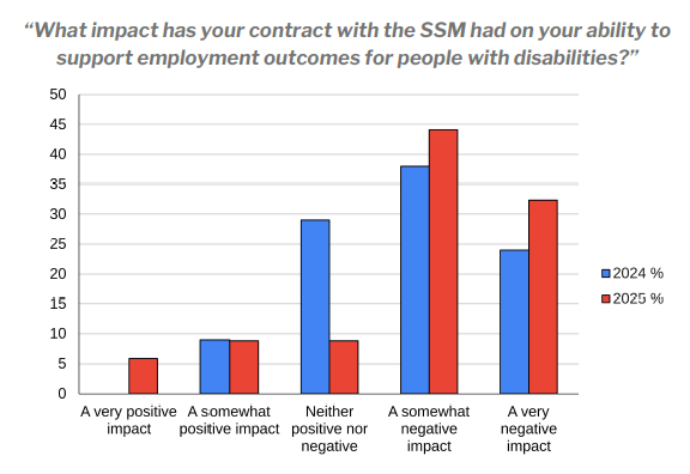
In 2025, 80% of respondents to our survey said that the province’s Employment Services Transformation had a negative impact on their ability to support job seekers with disabilities.
First Work recently released another report on the same topic. Their findings are quite similar, with almost no one having anything positive to say about the new system:
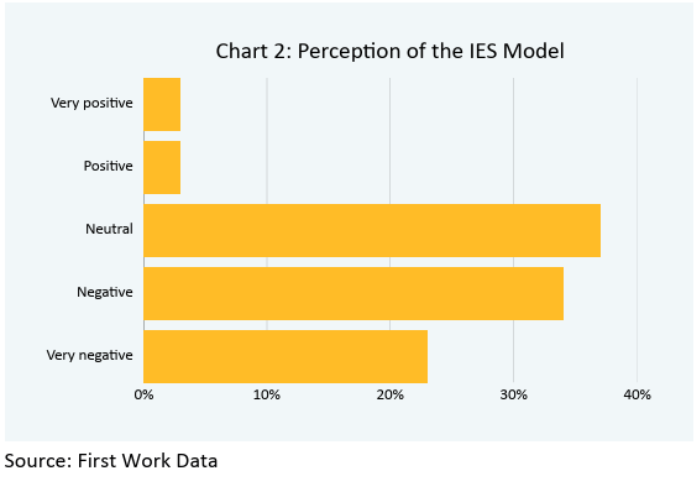
By our own accounting, more than a dozen (likely many more) service providers have stopped providing some or all employment services because they just can’t make the financial math work. Where employment service providers are still operating, staff have generally been reduced because of financial pressures: 77% of respondents in the First Work report said they now have fewer staff.
Employment services as a sector seems to be actively shrinking in Ontario. It also appears to be supporting worse outcomes than before the changes brought in by the province. This calls not for measured improvements, but for immediate and drastic changes. Many direct service organizations have been saying this for more than five years, and the province needs to act now to prevent things from getting any worse.
The feedback on Ontario’s Employment Services Transformation has been overwhelmingly critical from the beginning. There is less funding for organizations, fewer staff to do the work, and fewer people able to access the support they need to gain and keep employment. It is a program that is actively working against the government’s goals and compounding our disadvantages at a critical moment in our province’s history.
