
Housing
Protecting People from Transfer to Long-Term Care: In November 2022, the Ministry of Children, Community and Social Services (MCCSS) and Ministry of Long-Term Care (MLTC) released an updated and revised version of a document that guides the transfer of people with developmental disabilities from the developmental services sector into long-term care facilities. The document offers valuable insight into the perspective and approach of the Ministry of Children, Community and Social Services on this issue.
Protecting People from Transfer to Long-Term Care: In November 2022, the Ministry of Children, Community and Social Services (MCCSS) and Ministry of Long-Term Care (MLTC) released an updated and revised version of a document that guides the transfer of people with developmental disabilities from the developmental services sector into long-term care facilities. The document offers valuable insight into the perspective and approach of the Ministry of Children, Community and Social Services on this issue.

Innovations in Housing for People Who Have an Intellectual Disability: The shortage of affordable, accessible housing is one of the key barriers to community inclusion in Ontario. To address this problem, people with disabilities, their families, and the agencies that support them need to take a leading role in the creation of small-scale, individualized, community-based housing. This report from Community Living Ontario provides brief snapshots of nine examples of housing that supports independence and choice among people who have an intellectual disability. It is our hope that the document will contribute to greater awareness of what is possible, and to growth in people’s ability to live a life of their choosing.

Long-Term Care Is not a Solution for Younger Adults with Disabilities: Nearly 10% of long-term care residents are people with disabilities under age 65. To reduce our dependence on long-term care facilities, we need clear policy and programs that prioritize a concerted push for small-scale housing options bolstered by natural supports, which will reduce pressure on existing systems.
Long-Term Care Is not a Solution for Younger Adults with Disabilities: Nearly 10% of long-term care residents are people with disabilities under age 65. To reduce our dependence on long-term care facilities, we need clear policy and programs that prioritize a concerted push for small-scale housing options bolstered by natural supports, which will reduce pressure on existing systems.
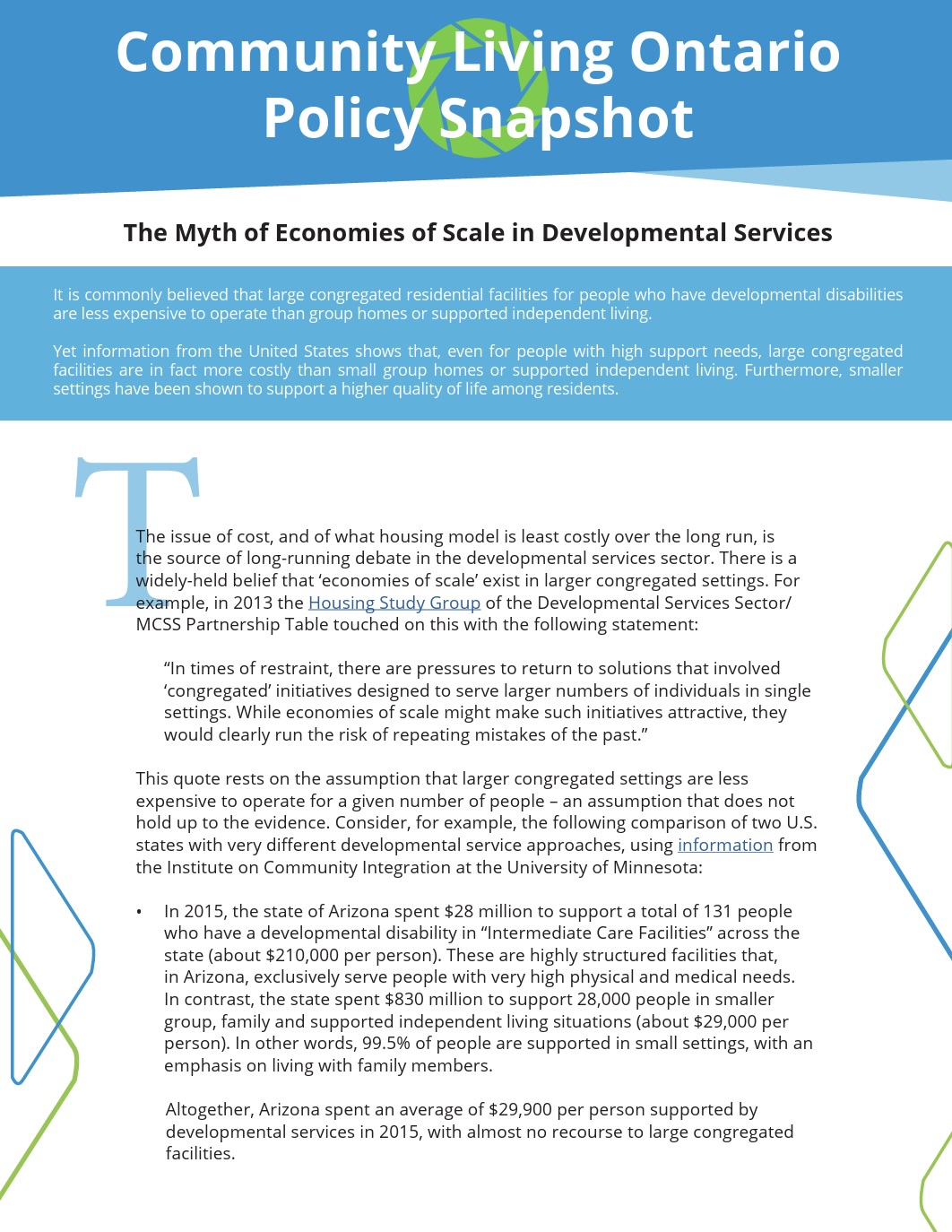
The Myth of Economies of Scale in Developmental Services: It is commonly believed that large residential facilities for people who have intellectual disabilities are less expensive to operate than more individualized models. However, this policy snapshot shows that, even for people with high support needs, large congregated settings are in fact more costly than small group homes or supported independent living.

Separating Housing from Disability Supports: An Idea Whose Time Has Come?
It is common for people who have intellectual disabilities to access housing and other needed supports from a single service provider. This paper argues that separating housing from supports would boost system flexibility and increase people’s ability to access the services they need.
Separating Housing from Disability Supports: An Idea Whose Time Has Come?
It is common for people who have intellectual disabilities to access housing and other needed supports from a single service provider. This paper argues that separating housing from supports would boost system flexibility and increase people’s ability to access the services they need.
